


This article is general information about how coverage programs work. It is not insurance, legal, or medical advice. Rules change, and they vary by state. It is imperative to check all the information from your state Medicaid agency, your health plan, and your doctor prior to any purchases.
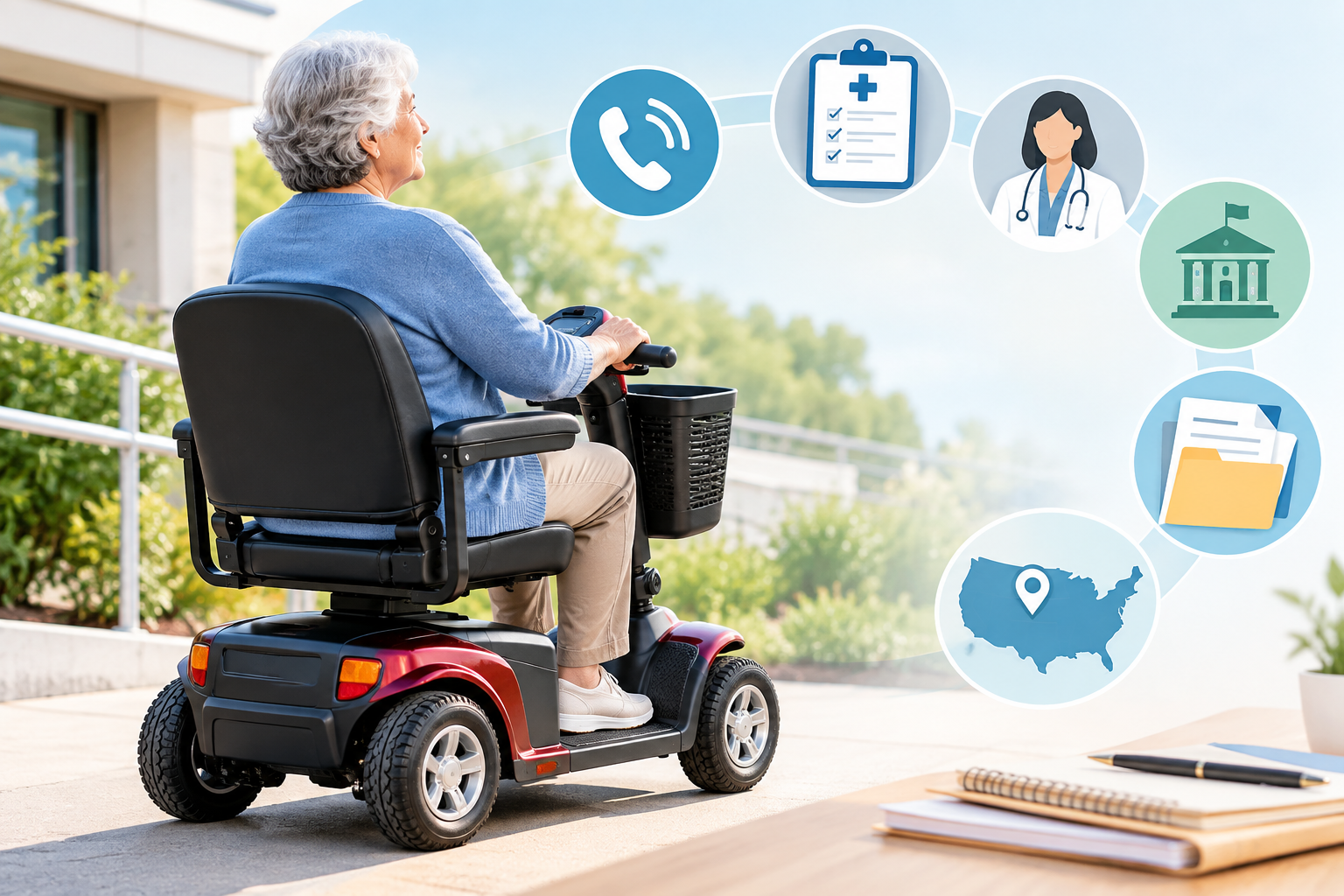
If you have been recently advised by your doctor that you require a mobility scooter, and you have Medicaid coverage, it is likely that you have already been told the same thing from three different sources - "Medicaid does not cover those." Medicaid can pay for a mobility scooter — what the paperwork calls a Power Operated Vehicle (POV). Whether it will pay for yours depends on four things: the state you live in, whether you also have Medicare, how your doctor documents your need, and how long you can wait.
This guide walks through all of it, in order, with the documents, the timelines, and what to do when you get denied. Because you probably will be asked to prove something first.
Short Answer
If Medicaid agrees to cover a mobility scooter, your state needs to classify the scooter as a durable medical equipment (DME). DME is an optional service for adults. Approximately half of the states classify the scooter as a DME, while the other half does it rarely by waiver or doesn’t do it at all. If you're 65 or older, or you've been on SSDI for 24 months, Medicare is usually the faster route. If you don't qualify anywhere, or you can't wait three months, buying directly is the honest answer — and the fastest one.
Here's the whole decision in one table:
|
Your situation |
Route to take |
Realistic timeline |
What you pay |
|
65+, or on SSDI 24+ months |
Medicare Part B (DME), with Medicaid as backup if dual eligible |
A few weeks to a few months |
20% coinsurance + deductible ($283 in 2026) |
|
Medicare and Medicaid (dual eligible) |
Medicare pays first, Medicaid covers most of the remainder |
A few weeks to a few months |
Often close to $0 |
|
Adult on Medicaid, your state covers DME |
State Medicaid, with prior authorization |
About 1–3 months |
Varies by state; often $0 |
|
Adult on Medicaid, your state doesn't cover DME |
HCBS waiver, if you qualify for one |
Months to years |
Varies by state |
|
You don't qualify, or you can't wait |
Buy it: payment plans, HSA/FSA, refurbished |
Days |
Full price |
1. Will Medicaid pay for your scooter?
Maybe. And the reason the answer is always "it depends" comes down to one structural fact. Medicaid doesn't have to cover durable medical equipment for adults. Medicaid is a federal-state partnership. The federal government sets a floor of mandatory benefits — inpatient care, physician visits, lab work, and so on. Durable medical equipment is optional for adults. Each state decides whether to include it in its state plan, and if so, how much and for whom. Children's coverage is broader, because a 1967 amendment requires states to cover certain equipment for kids under 21.
That single fact explains everything that follows:
- Why the answer is different in California than in Texas
- Why two people with the same diagnosis get different answers
- Why a forum post from 2019 about your state may no longer be true
For many adults on a standard state Medicaid plan, a mobility scooter is simply not a covered item. If that's your situation, the rest of this article still applies to you — you just skip ahead to the waiver route and the alternatives.
Two terms are worth learning now, because you'll see both: You'll say mobility scooter. Your doctor, your plan, and every form you sign will say Power Operated Vehicle (POV) or Power Mobility Device (PMD). They mean the same thing. When you call your plan, use their words. It gets you to the right person faster.
2. Do you actually qualify? There are two separate gates
Most articles blur these together. They're independent, and you have to pass both.
Gate 1: Financial eligibility
The first requirement is qualifying for Medicaid itself, which is primarily based on your income.Although the exact requirements differ by state, Medicaid is supposed to be used by those who have low income. For instance, the income level of an individual living alone may not exceed about $1,300 - $1,800 per month in most states, but this figure may be different for the elderly, disabled, or married people.
In some cases, the assets of individuals who need to be enrolled in Medicaid will also be checked. This can include:
- Savings accounts
- Investment accounts
- Additional property
However, many programs exclude your primary residence, personal belongings, and one vehicle.
It is also essential to understand that being eligible for Social Security retirement benefits does not necessarily preclude an individual from qualifying for Medicaid. Many people who receive Social Security retirement benefits are also eligible for Medicaid, subject to their income levels and the laws in their state. A useful guideline for this is as follows:
- If you have a low income and are already covered by Medicaid, you can be considered for wheelchair assistance.
- If you have a high income and exceed Medicaid income limits, it is less likely that you will be covered by Medicaid unless you fit some specific criteria.
Since income thresholds vary from year to year and state to state, the best way to know is to look at your state’s requirements for Medicaid eligibility.
Gate 2: Medical necessity
This has nothing to do with how poor you are. It's about functional evidence, and it's where most applications die. Coverage programs generally look for all of the following:
- Your mobility limitation affects your daily activities inside your home — what the regulations call MRADLs: toileting, dressing, grooming, feeding, and moving around your living space.
- A cane or walker isn't enough. You have to fail the cheaper option first. The rule exists so plans don't pay for a $1,200 scooter when a $40 walker would do.
- You can't push a manual wheelchair effectively. Usually because your upper body strength or endurance isn't sufficient.
- You can operate the scooter safely — get on and off, steer with the tiller, stay stable while seated.
- Your home can accommodate it. Doorways, hallways, turning space, flooring, thresholds, and whether you can actually use it in the bathroom and bedroom. A standard interior doorway is 32 inches wide; measure yours before you start.
- Your weight is within the device's rated capacity. This determines which billing code applies, and the codes aren't interchangeable.
The part nobody tells you: write down what you can't do at home
This is the single most common reason applications get denied. "This patient has difficulty walking" is a worthless sentence on a medical necessity form. So is "patient needs a scooter to get around."
What works is specific and domestic:
"Patient cannot walk from the bedroom to the bathroom without stopping to rest. Cannot stand long enough to prepare a meal or shower without sitting down. Has fallen twice in the past three months, once in the hallway. Cannot carry items while using a walker because both hands are needed for support.
Notice what's in there: specific rooms, specific activities, a documented fall history, and a reason the walker fails.
What coverage programs will not accept as a reason
Write these down before you call, because they're disqualifying when they're your primary stated need:
- You want it for shopping, errands, or getting around town
- You want it for outdoor use, trails, or uneven ground
- You want it for community activities, church, or visiting family
- You want it so you can travel or take cruises
Coverage is built around getting around inside your home. Everything else may be true and important, but it isn't what the assessment is measuring. If your doctor writes "needs scooter for outdoor mobility," expect a denial.
3. The documents you need
Print this table. Take it to your doctor's office. Every row is a real requirement somewhere, and missing any one of them can stall your application for weeks.
|
Document |
What it proves |
Who provides it |
|
Medicaid ID/eligibility confirmation |
That you're covered at all |
You |
|
Face-to-face examination notes |
That your mobility is functionally limited |
Your doctor |
|
Written order (7 elements — see below) |
The specific equipment being ordered |
Your doctor |
|
Letter of Medical Necessity (LMN), or a Certificate of Medical Necessity (CMN) |
The formal argument for coverage |
Your doctor, PT, or OT |
|
PT / OT functional assessment |
Objective mobility testing (required in some states) |
Physical or occupational therapist |
|
Home assessment |
That the device is usable where you live |
Your DME supplier or a therapist |
|
Prior authorization request |
Your plan's formal approval request |
Your DME supplier |
|
Supplier's enrollment confirmation |
That the supplier is contracted with your plan |
Your DME supplier |
The 7-element written order
This format comes from Medicare's DME rules, and many state Medicaid programs use the same or a similar standard. Hand this list to your doctor. An order missing any element is an invalid order, and the supplier cannot fill it.
- Beneficiary's name
- Description of the item ordered
- Date the face-to-face examination was completed
- Relevant diagnoses
- Length of need — how long the equipment is expected to be needed
- Treating practitioner's signature
- Date of signature
Two deadlines that quietly kill applications
These are the most-missed rules in the entire process. They're worth asking about explicitly.
- The written order must be completed within 6 months after the face-to-face examination. If your doctor signs it seven months later, you start over.
- The doctor must send the face-to-face notes and the order to the supplier within 45 days of the examination.
If you're working with a doctor's office that is slow with paperwork — and many are — tell them about both deadlines on day one. Ask them to send the documentation to the supplier the same week they sign it.
4. Step by step: the application process
Six steps, in order. The order matters.
Step 1 — Call your state Medicaid office or your managed care plan
Do this before you see a doctor. You need to know whether this is even a covered item in your state, and what their specific process looks like.
Ask these five questions:
- "Is a power operated vehicle covered under my plan, and under which benefit?"
- "Does it require prior authorization?"
- "What documents do you need from my doctor, and is there a required form?"
- "Which DME suppliers in my area are enrolled with you?"
- "What is your decision timeline, and how do I appeal a denial?"
Write down the name of the person you spoke with and the date. Get a reference number if they offer one.
Common trap: calling the general member services number and getting a scripted answer from someone who has never handled a DME request. Ask to be transferred to the DME or equipment department.
Step 2 — Book a dedicated face-to-face visit
This is not a routine follow-up. It needs its own appointment, and it needs to happen in person with the practitioner who will sign the order. The visit has to document your functional limitation in the specific way described above. Bring a written list of what you can't do at home. Hand it to the doctor. Don't rely on remembering it during a 15-minute appointment.
Step 3 — Get the 7-element order and the letter of medical necessity
Give your doctor the 7-element checklist. Ask directly whether they will also write an LMN that states, in functional terms, why a scooter is necessary and why a walker is insufficient. Some offices charge for this letter. Pay it.
Step 4 — Choose a supplier enrolled with your plan
Not every DME company bills Medicaid, and not every one that does is a good experience. When you call, ask:
- "Are you an enrolled Medicaid provider for my plan?"
- "Do you handle the prior authorization, or do I?"
- "How long is your current wait for this equipment?"
- "Will you do the home assessment?"
- "Do you have this model in stock, or is it backordered?"
Common trap: ordering from a supplier who isn't enrolled with your specific plan. You find out after delivery, when the claim is rejected and you're holding the bill.
Step 5 — Home assessment and prior authorization
The supplier (or a therapist) may visit your home to confirm the equipment will work there — doorways, turns, flooring, where you'll charge it. Then they submit the prior authorization request. The federal Prior Authorization Program for DMEPOS allows 10 days to process standard requests and 2 days for expedited requests. The approval of the prior authorization lasts for 6 months. Medicaid timelines for state Medicaid programs vary. Please consult your plan about your state’s timeline.
Common trap: the plan requests additional documentation. When that happens, the review clock typically restarts. Respond the same week.
Step 6 — Delivery, training, and your files
Once approved, the equipment is delivered and set up, usually with a short training session. Before the delivery team leaves:
- Confirm the device matches what was authorized, exactly
- Get trained on charging, disassembly, and the freewheel mode
- Ask what happens if a part fails
- Keep every document. Every form, every letter, every approval, in one folder.
That folder is what you'll use if anything goes wrong later, including a retroactive denial.
5. What if Medicaid denies it?
First, know what you're up against — and why a denial is not the end of the story. Medicaid managed care plans deny about 12.5% of prior authorization requests. The above statistic is based on a federal audit of data from 2019, and this is the latest statistic available.
The really important statistic here: 89% of these rejections go unchallenged. In other words, nearly nine out of ten people just take the rejection at face value and walk away from it. Of those who do challenge the rejection, one-third succeed in having the rejection reversed. And among the cases where the plan's decision was upheld, only about 2% ever reach a state fair hearing.
Compare that to Medicare Advantage, where denials run around 5.7% and roughly 82% of appealed denials get overturned. Appeals work. Most people just never file one.
"Denied" does not mean "no." It usually means "not with these documents."
How to appeal
- Read the denial letter carefully. Find the specific reason. "Did not meet criteria" is not specific enough — call and ask which criterion failed.
- Fix the actual gap. If the denial says there's no evidence a walker was tried first, the answer is a new letter from your doctor documenting the walker trial. Resubmitting the same packet gets the same answer.
- Get a specific letter from your doctor. Ask them to address the stated reason directly, in functional terms, and reference your chart.
- Consider a specialist letter. A physical therapist's or occupational therapist's functional assessment carries weight that a general practitioner's note may not.
- Watch the deadline. Appeal windows are commonly 30–60 days from the denial. Some plans allow longer, some shorter. Find out your window on the day the letter arrives.
- Escalate if you need to. If the plan upholds the denial, ask about a state fair hearing. Very few people get there — which is precisely why the outcomes on appeal tend to be better.
Keep a log: date you called, who you spoke with, what they said. If you end up in a hearing, that log is your evidence.
6. If you have Medicare too (dual eligible)
If you have both Medicare and Medicaid, your path is clearer than most — and different from either program alone.
Medicare generally pays first, and Medicaid picks up most of what's left. Since Medicare covers power operated vehicles as DME under Part B, dual eligible beneficiaries often end up paying very little.
The tradeoff is that Medicare's rules are stricter than you might expect:
- Coverage is built around use inside the home. Outdoor and community use don't count toward medical necessity.
- You pay 20% of the approved amount, after meeting the Part B deductible — $283 in 2026.
- Medicare covers the standard power operated vehicle, not the model you'd choose for yourself.
For the full breakdown of what Medicare does and doesn't cover, see our guide to does Medicare covers mobility scooters.
7. What Medicaid won't cover
Knowing what's off the table saves you months.
Higher-capacity power vehicles in some categories. The mobility scooter coding depends upon the weight capacity and includes the HCPCS code series as follows: K0800 up to 300 pounds, K0801 301-450 pounds, K0802 451-600 pounds. Beyond this weight range, the code falls into the following series (K0806, K0807, K0808) which currently does not come within the reasonable and necessary criteria and cannot be authorized by the insurance company. You'll see those codes listed on plenty of websites as if they were available options. They aren't.
Lightweight travel and folding models. Coverage is built around a standard power operated vehicle. The ultra-light folding scooters designed for travel and car trunks generally don't meet the coverage criteria, because they're engineered for portability rather than for daily indoor use.
Anything justified mainly by outdoor use. Covered above, but it bears repeating, because it's the most common fatal error in an application.
Home modifications. Ramps, widened doorways, stair lifts, and bathroom retrofits are generally not DME. Some waiver programs and state assistive technology programs cover parts of this, but you have to ask specifically.
Upgrades, cosmetic choices, and preferred brands. You get what the coverage criteria describe, from a supplier your plan contracts with. Color, trim, and premium features aren't part of the medical justification.
Retroactive reimbursement. If you buy a scooter first and then apply, you will generally not be reimbursed. Prior authorization has to come before the purchase. This one ruins people financially, so say it plainly: do not buy first and expect to be paid back. Ask your plan in writing whether any exception exists before you spend anything.
8. If you can't wait — or don't qualify
If the process above doesn't fit your situation, you're not out of options. In order of how quickly they tend to work:
Home and community-based services (HCBS) waivers. These can cover equipment that the standard state plan doesn't, and eligibility is defined differently. The catch is the wait. Waiting lists can run one to three years, and some states have closed lists. If you're young and need coverage for years, it's worth getting on the list now even if you buy something in the meantime.
State assistive technology programs. Every state runs one, funded federally. They offer device demonstrations, short-term loans, refurbished equipment, and sometimes low-interest loans. They're underused because almost nobody knows they exist.
Veterans benefits. If you're a veteran, the VA has its own equipment program with its own rules, and it's often more generous and faster than Medicaid. Check with your VA facility before assuming you have to go through the state.
Charitable and community programs. Call 211 to reach your local referral service. Ask about Easterseals, Lions Club, Independent Living Centers, and hospital equipment loan closets. Faith communities sometimes maintain equipment lending programs too.
Buying it yourself. If time is the binding constraint, this is usually the fastest path — often within days. Three ways to make it affordable:
- Refurbished, open-box, and returned units. These are typically a fraction of the new price and carry the same function. Look at our used and refurbished mobility scooters if you want to see what's typically available.
- HSA or FSA funds. Mobility equipment prescribed for a medical need is commonly an eligible expense. Confirm with your plan administrator before you buy.
- Payment plans and financing. Many sellers offer installments. Compare the total cost, not the monthly payment.
A note on which device makes sense: the ultra-light folding scooters, like our T550 mobility scooter , are built for people who need something portable they can lift into a car and take on a plane.
9. The Bottom Line
Obtaining a mobility scooter through Medicaid is much more about going through the correct procedure than selecting the proper mobility scooter. Medicaid coverage for mobility scooters may vary based on states, but typically approval can be obtained by proving the necessity of obtaining a scooter and explaining why one cannot perform activities without it.
A good first step will be making a call to your Medicaid agency or health insurance company.Find out what is covered, what documents are required, which suppliers are enrolled, and how to appeal if you are denied. Then work with your doctor to complete the face-to-face evaluation and supporting documentation, and keep every document in one place.
If Medicaid isn't an option, or you cannot wait for the process, other paths may include an HCBS waiver, a state assistive technology program, veterans' benefits, community resources, or purchasing a scooter yourself.
10. FAQ
How long does it take to get a mobility scooter through Medicaid?
Plan on one to three months at best, and three to six months as a realistic average. The written order, the doctor's documentation, the home assessment, and prior authorization each add weeks. Requests for additional documentation restart the review clock.
Can a family member apply for a mobility scooter through Medicaid?
Often yes. A family member can usually make calls, gather documents, and coordinate with the supplier, and many plans accept an authorized representative. Signing the order and conducting the examination are the practitioner's role. If the person you're helping can't manage their own affairs, ask the plan what authorization or power of attorney they require.
What if Medicaid denies my mobility scooter?
Then appeal, and look for the cause in the denial letter. Appeals succeed in reversing around one-third of denials made by the plan, but 89 percent of all denials are not even appealed. Correct whatever problem is mentioned in the denial letter, obtain a more specific letter from your doctor, and then file an appeal on time, which is generally within 30 to 60 days.
Do you have to be on disability to get a mobility scooter from Medicaid?
No. Disability status can establish financial eligibility, but it isn't the medical test. What matters is documented functional limitation affecting your daily activities at home. Many people qualify on income alone and still meet the medical criteria.
Does Medicaid cover mobility scooter batteries and repairs?
Sometimes, and it depends on how the original equipment was obtained. If your plan owns or paid for the device, repairs and batteries are frequently covered as part of the benefit. If you bought it yourself, they generally aren't. Ask before you pay a repair bill.
Sources and references
- LCD L33789 — Power Mobility Devices — CMS Medicare Coverage Database. General coverage criteria, MRADL definitions, POV-specific requirements, the two-part weight rule, and the Group 2 denial language.
- NCD 280.3 — Mobility Assistive Equipment — CMS. The clinical criteria for mobility equipment, including the exclusion of devices needed for reasons outside the home.
- Power Mobility Devices — CMS. Plain-language summary of coverage conditions, the face-to-face requirement, and the POV vs. power wheelchair distinction.
- A52498 — Power Mobility Devices Policy Article — CMS. The statutory 7-element order requirement, the 45-day delivery of the order, and the hospital-discharge exception.
- A55426 — Standard Documentation Requirements for All Claims Submitted to DME MACs — CMS. General documentation rules, including that attestation letters such as a letter of medical necessity are not part of the medical record.
- DMEPOS Required Prior Authorization List update — Federal Register, January 13, 2022. The six power mobility codes added to the Required Prior Authorization List.
- Medicare costs — Medicare.gov. 2026 Part B deductible, premium, and the 20% coinsurance on durable medical equipment.
- High Rates of Prior Authorization Denials by Some Plans and Limited State Oversight Raise Concerns About Access to Care in Medicaid Managed Care — HHS Office of Inspector General, OEI-09-19-00350, July 2023. The 12.5% Medicaid MCO denial rate, 5.7% Medicare Advantage rate, 89% non-appeal rate, one-third overturn rate, and 2% fair hearing rate.
- New OIG Report Examines Prior Authorization Denials in Medicaid MCOs — KFF. Analysis of the OIG findings, including the 82% Medicare Advantage appeal overturn rate.
- Prior Authorization Process Policies in Medicaid Managed Care — KFF, updated August 2025. Medicaid MCO prior authorization decision timeframes and the 2026 rule change.


