


When people try to understand the transport chair vs wheelchair, the question that comes to mind is not only about the definition. The real issue at stake is very straightforward: which one suits me or my loved one?
Both pieces of equipment seem quite alike at first sight: they are used for moving around, both of them have seats and wheels, and both are used for everyday assistance tasks. However, the reality differs from the initial impression a lot.
Understanding the Real Difference in Simple Terms
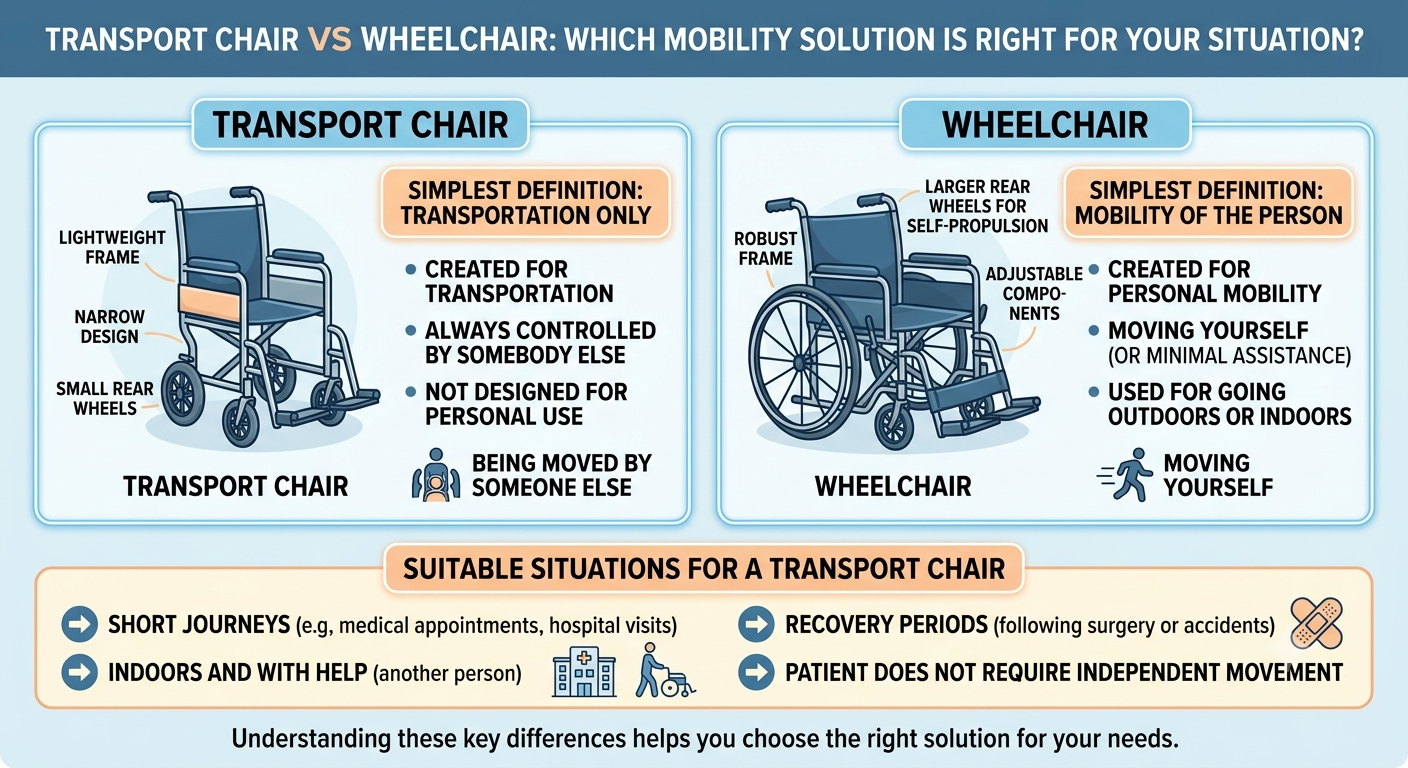
The transport chair is created mostly for transportation and is light-weighted, narrow, and easy to push, but still it will be controlled by somebody else all the time. It is not designed for personal use.
Unlike that, the wheelchair is created for the mobility of the person who controls it personally. He uses it for going outdoors or indoors and for his everyday moving.
In simple terms:
- Transport chair = being moved by someone else
- Wheelchair = moving yourself (or with minimal assistance)
This single difference already determines most of the user experience.
Suitable Situations for the Use of a Transport Chair
The transport chair is usually the best option when there is an absolutely specific scenario:
- Short journeys such as visits to the hospital or medical appointments
- Indoors and with the help of another person
- Recovery periods following surgical procedures or accidents
- Cases in which the patient does not require independent movement
Transport chairs are small and light, making it easy to maneuver and store them. Yet, they are not meant for long-term use.
When Are Traditional Wheelchairs Useful?
A regular wheelchair is much more adaptable and appropriate for:
- Every day use both indoors and outdoors
- Individuals who require more independence
- Prolonged periods of sitting during the day
- Cases when there is no constant presence of a caregiver
But despite all that, although wheelchairs give more independence to their owners than transport chairs, one big problem remains — manual effort is necessary. And for some people, particularly older individuals or those with weaker upper limbs, this becomes a lifelong problem.
The Real Problem Most Users Face
Over time, many users begin to notice a common issue: Even with a wheelchair, mobility is still limited by physical strength or caregiver availability.
This often leads to situations like:
- Feeling tired after pushing for long distances
- Relying on others to go outside
- Limiting daily activities due to fatigue
- Avoiding longer trips or outdoor outings
In other words, the limitation is no longer just the chair—it is the effort required to use it.
Here is Where Electric Wheelchairs Come into Play
An electric wheelchair is much more than an improved model of the wheelchair.
As a result of electric wheelchair technology, the individual does not need any help or any physical efforts from him/herself – everything is controlled easily and comfortably.
A power wheelchair provides the opportunity for its owner to:
- Move independently without any caregiver's help
- Cover greater distances without feeling tired
- Go shopping, visit relatives and spend time outdoors
- Stick to their everyday schedule without any problems
That is why electric wheelchairs have become so popular among people who have already used wheelchairs before.
When an Electric Wheelchair Becomes the Better Choice
An electric wheelchair is especially suitable if:
- You use a wheelchair daily or for long hours
- You often travel outside the home
- You do not always have someone to assist you
- You experience fatigue when using a manual wheelchair
- You want more independence and freedom of movement
In these cases, electric mobility is not just a convenience—it becomes a practical daily necessity.
A Modern Example: Portable Electric Wheelchairs
Advancements in modern mobility technology have resulted in the increased efficiency of the electric wheelchair. In today's portable electric wheelchairs, the priority is to create a blend of functionality and practicality.
For instance, Aotedor portable electric wheelchairs use an advanced and lightweight design, weighing about 35–39 lbs (excluding the battery). The folding design of these wheelchairs makes them compact, with measurements of about 30" x 16.5", which enables them to be stored inside most vehicle trunks. In other words, you can enjoy the benefits of power and portability together.
Making the Right Choice for You
All that depends solely on the specifics of your daily routine:
- If occasional mobility is required with assistance → a transport chair might work fine
- If regular mobility is required → a wheelchair would do better
- If complete independence along with saving energy is the aim → an electric wheelchair might be the optimal choice.
Rather than limiting yourself to figuring out what each device is meant to be, it’s better to concentrate on how you’ll use it in real life.
Final Thoughts
It’s not only about the design; it’s about gaining more freedom. The purpose of a transport chair is to get you around when there is someone who can help you out. Though a manual wheelchair offers more independence, an electric wheelchair offers greater comfort and freedom in performing daily tasks. In any case, whether the wheelchair in question is cheaper or not makes little difference. The important factor here is comfort while using it on a daily basis.


