


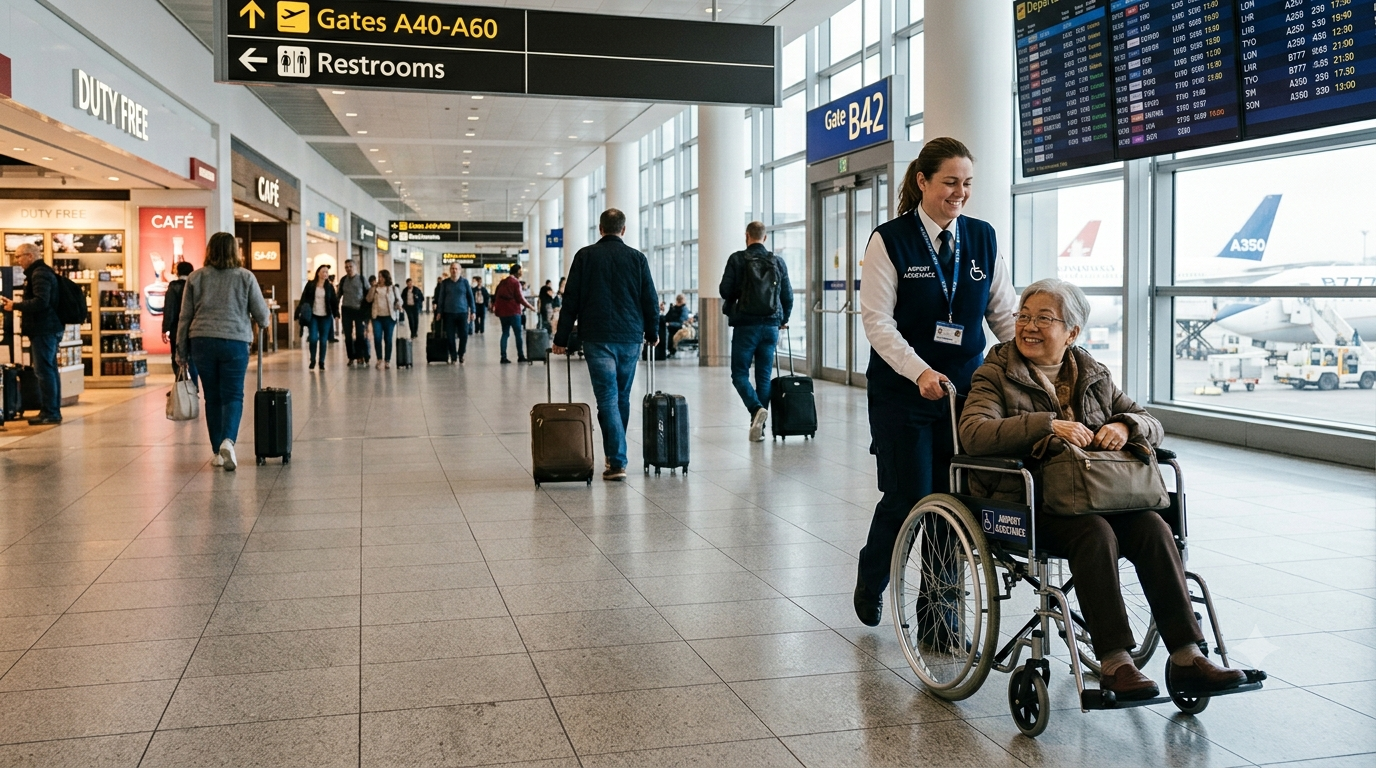
Moving around an airport can be challenging if one faces problems moving around on foot, standing up for long periods of time, or being a wheelchair user. Airports are always huge places, and there is a lot of walking from the check-in point to the departure gates.
However, there is an option for those who experience such difficulties and require help in the form of wheelchair assistance. Airports in the United States offer such a service to their disabled customers. For people who use wheelchair assistance for the first time, there might be some questions. How to order wheelchair assistance? What will happen when arriving at the airport? Who will help to go through security? How to get through a connecting flight? What to do in case of wheelchair assistance delay?
The guide gives answers to all those questions and more.
Who is Eligible for Wheelchair Service?
Not being able to walk does not automatically make you eligible to request wheelchair assistance services.
Wheelchair assistance is required when you are unable to walk long distances, unable to stand long hours, unable to use stairs, and are unable to walk through an airport. Although you can be capable of walking from your car to the building entrance at the airport, you are not able to walk all the way to the boarding gate.
While requesting for the assistance, make sure to inform the airline about what you can and cannot do. For instance, you may say "I can walk short distances, but I cannot walk long distances."
How Do You Request Wheelchair Assistance?
It is advisable for people to ask for wheelchair assistance when they are booking flights. All airlines offer Accessibility, Special Assistance, or Disability Assistance. People may also contact the airline if they fail to see such a choice on the website. It is imperative for people to let the airlines know what they need. For example, one may choose to inform the airlines about their inability to walk short distances or climb stairs.
When one uses his/her own wheelchair, he/she must inform the airline whether his/her wheelchair is a manual, power, or mobility scooter. In case of a power wheelchair, some extra information might need to be supplied to the airline regarding the battery, size, and weight of the wheelchair. One needs to make sure he/she confirms his/her request prior to traveling, especially if there have been any changes to his/her flight.
What Happens When You Arrive at the Airport?
Once you get there, go to the counter of your airline and inform the staff that you need wheelchair service. In case you have requested the service earlier, you can say, “I requested wheelchair assistance.” However, in case you have not made any request before the trip, you can say, “I need wheelchair assistance to my gate.”
Afterward, a member of the staff will help you get around the airport. This can involve taking you from the check-in to security and then from security to your boarding gate. Boarding assistance may also be provided.
It could depend on how the airport and the airline operate. What should be done is informing the airport’s personnel of the type of help you need. Moreover, it is important to give yourself enough time. Requesting wheel chair assistance when there are no previous plans for that means you will have to wait for a while.
Will Someone Help You Through Security?
However, even though you are traveling in a wheelchair, you will still be required to undergo the security procedure. There is provision in the security procedure for people who find it difficult to stand and walk.
In case you find it difficult to stand for prolonged periods of time, you should inform the security personnel. You can say, "I find it difficult to stand for prolonged periods of time." In a similar manner, in case you find it difficult to walk in parts of the screening area, you should inform them about this too.
What Happens When You Board the Plane?
Once you have reached the gate, assistance will be given to get on the aircraft and reach your seat. If you can walk but require some assistance, an attendant may assist you from the airport wheelchair to the plane. In case you cannot walk through the narrow aisle of the plane, then the aisle chair may be required.
An aisle chair is a smaller wheelchair that is designed for use in the airplane. It can help move a passenger from the entrance of the plane to his/her seat. In case you know that you cannot walk to your seat, you should inform the airline before boarding by saying “I need an aisle chair to reach my seat.”
What If You Have a Connecting Flight?
In case you have a connecting flight, it is essential that the airline should know that you will require assistance while making the connection. For instance, if you travel on an aircraft from Los Angeles to Dallas and then to New York, you may require help in transferring from your initial flight to the connecting flight. Upon reaching the connecting airport, let the authorities know that “I have a connecting flight and need wheelchair assistance to my connecting gate.”
In case you do not have much time, let the authorities know immediately, as it may take quite a bit of time to cover large airports. Ensure that your wheelchair assistance request is made while making your booking for all the flights.
What If You Have a Wheelchair That Is Not Provided by the Airline?
If you plan to travel using a wheelchair that you own, ask how the airline plans to deal with your wheelchair on board. In case of a manual wheelchair, inquire when and where you will retrieve your wheelchair after arrival. Before handing over your wheelchair to the airline, you should consider taking some photos of the same. It will help you document the condition of your wheelchair before traveling. You should also keep the tag or receipt issued by the airline.
In case of a power wheelchair or mobility scooter, you should contact the airline prior to your travel date. They may require additional information regarding the battery and size of your wheelchair. You may consider documenting instructions for operating your wheelchair.
What if the Wheelchair Assistance Is Late?
Sometimes wheelchair assistance is late because of unforeseen circumstances. You may come to the airport, but no one will greet you, or you may reach the connecting airport, and there will be no one waiting for you. In case you wait for too long, do not sit and wait. Go to the airport counter or find an agent at the gate and let him know about your experience. For example, you might say, "I requested wheelchair assistance, but nobody came to me."
In case you are worried about missing your flight due to the delay, you might say, "I am afraid that I might miss my flight as I am waiting for wheelchair assistance." If the employee is unable to provide an answer, you might request an audience with the manager.
What Do You Do If There Is a Problem With the Airline?
There are laws in place for U.S. airlines which ensure that the rights of disabled individuals traveling in their aircraft are protected. In case there arises an issue concerning your disability which cannot be resolved by the regular crew members, you can request for a Complaint Resolution Official, or CRO. The Complaint Resolution Official is the airline’s representative who knows how to resolve any difficulties regarding disabled passengers.
The only thing you need to do is ask, “May I talk with the Complaint Resolution Official?”
You don’t have to be familiar with any law or even use complex language. Just tell your story and what you need from the airline. Should your issue remain unsettled, then you can get in touch with the U.S. Department of Transportation.
What If Your Wheelchair Is Damaged?
If you are traveling with your own wheelchair, it would be wise to check your wheelchair once you have disembarked from the aircraft. Some of the problems that might be experienced may include wheel damage, damage to the control mechanisms, damage to the armrests and footrests, among others.
In case you notice such an issue, inform the airline immediately. Keep pictures of the damage along with your wheelchair tag and any paperwork issued by the airline.
It is even more important when you use a powered wheelchair.
Common Problems and What to Do
|
Problem |
What to do |
|
Wheelchair assistance is late |
Contact the airline staff and ask for help. |
|
You may miss your flight |
Tell the airline that you have been waiting for wheelchair assistance. |
|
Nobody helps you during a connection |
Tell the staff you have a connecting flight and need help to your next gate. |
|
No wheelchair is waiting after landing |
Tell the flight crew or airline staff. |
|
You cannot walk to your seat |
Ask for an aisle chair. |
|
Your wheelchair is damaged |
Take photos and report it to the airline before leaving. |
|
Your flight is changed |
Confirm wheelchair assistance for the new flight. |
|
Staff cannot solve your problem |
Ask for a CRO. |
The most important thing is to tell someone as soon as there is a problem. Do not wait until you have already left the airport.
Advice on a Less Stressful Airport Experience
A bit of preparation can go a long way in making your travel experience better. Make sure to arrange for a wheelchair before your journey and that this information appears in your reservations. If you have a connecting flight, inform the airline that you will require assistance during your connecting flight too. Allow some extra time at the airport. For those who need to travel using an electric wheelchair or mobility scooter, it is recommended that you contact the airline prior to your trip for information about your battery and equipment requirements.
For travelers with their own wheelchairs, it is advisable to take photos of your wheelchair before you hand it over to the airline and keep your wheelchair receipt. Upon arrival at your destination, make sure to check your wheelchair upon arrival at the airport. More importantly, be specific about your needs. Stating “I can walk short distances but not long distances” provides the staff with much more information than “I need assistance.”
Your Rights as a Passenger with Disabilities in the USA
If you are a passenger with disabilities in the USA, some rights protect you as a person who uses air transport in the country. In particular, according to the Air Carrier Access Act (ACAA), airlines are supposed to give certain kinds of assistance.
Information about the mentioned rights can be found on the website of the U.S. Department of Transportation, including wheelchair and escort assistance, boarding, deplaning, connecting flights, and handling of wheelchairs and mobility aids.
Firstly, tell the staff at the airline what has happened and get their help. In case they are unable to sort things out, seek out the Complaint Resolution Official (CRO). Additionally, in case of any urgent issues that need sorting out, you can also approach the U.S. Department of Transportation. Considering that the rules and procedures of the airlines may change, it is recommended to find out the most recent information from DOT and your airline.
Conclusion
If one has difficulties in moving or uses a wheelchair, then the assistance provided will greatly help in making your travel much more comfortable. This includes the process of requesting help from the airline, which goes through check-in, security, gate, boarding, transfer flights, and finally arriving at the destination.
As the first thing to do, one should plan and describe his/her needs in advance. One should let the airline know what he/she can do and what not, allocate some additional time, and ensure that your wheelchair request applies to all your flights if there is a transfer.
In case one has his/her wheelchair with him/her, especially the electric one, it is advisable to find out from the airline company how the wheelchair will be handled. After landing, one should inspect his/her wheelchair for any damage caused. In case of problems, one should address them immediately. One should talk to the airline staff, ask for a supervisor if necessary, and request a Complaint Resolution Official (CRO) in case one's disability issue is not solved.


