


The width of the wheelchair is arguably one of the key measures that need to be considered when picking out a wheelchair to buy. This is because it is not simply a question of the wheelchair being able to fit in doorways, but also the overall comfort, posture, and maneuverability of the wheelchair user.
Standard wheelchairs usually measure somewhere between 24 and 27 inches (61-69 cm) wide, but what is required is not solely determined by the dimensions of the wheelchair itself but many other factors related to both the body and environment of the wheelchair user. Here we will discuss different wheelchair width sizes, the effect of the dimensions of the wheelchair on accessibility, and how to choose the correct wheelchair width.
Clinical Definition of Wheelchair Width
In rehabilitation and mobility practice, wheelchair width is classified into two primary measurements:
1. Seat Width (Internal Seating Dimension)
Seat width refers to the usable sitting surface between the inner armrests or seat rails.
- Typical range: 16–22 inches (40–56 cm)
- Determines pelvic positioning and sitting stability
- Directly influences pressure distribution across the hips and thighs
2. Overall Width (External Frame Dimension)
Overall width is measured from the outermost point of one wheel to the other.
- Typical range: 24–32 inches (61–81 cm)
- Determines environmental accessibility (doors, corridors, bathrooms)
- Influenced by wheel camber, frame structure, and armrest design
Clinically important note: Overall width is typically 6–10 inches greater than seat width, depending on wheelchair configuration.
Wheelchair Dimensions
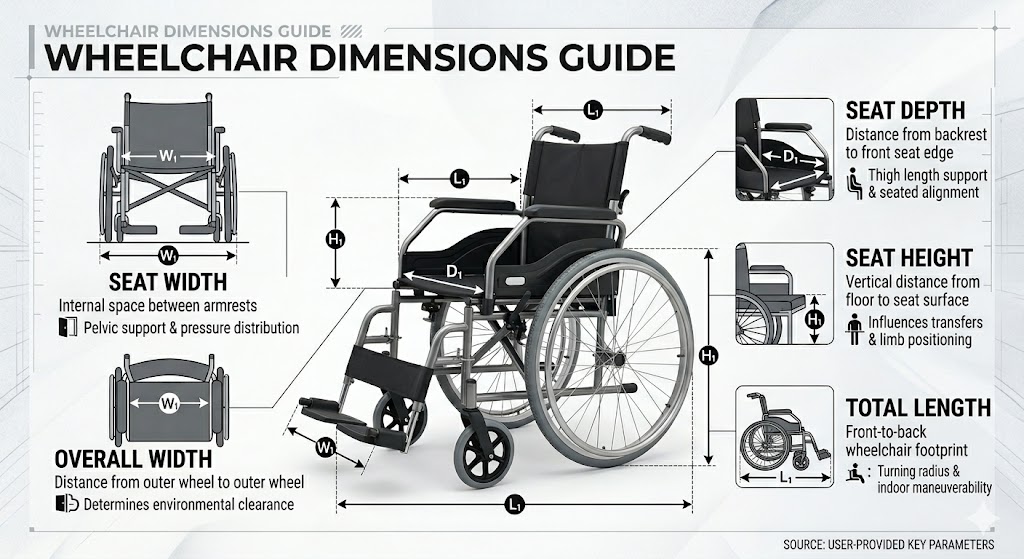
Most of the time, individuals tend to consider only one dimension while purchasing their wheelchairs, i.e.,standard wheelchair width. On the contrary, there are a variety of other dimensions that play an essential role in determining the wheelchair's comfort and mobility. These include dimensions like seat width, seat depth, seat height, and overall length. Below is the list of some of the important measurements.
Key parameters include:
|
Dimension |
Definition |
Functional Role |
Clinical / Practical Impact |
|
Overall Width |
Distance from outer wheel to outer wheel |
Determines environmental clearance and passage ability |
Affects doorway access, corridor navigation, and turning feasibility |
|
Seat Width |
Internal seating space between armrests |
Primary factor for pelvic support and pressure distribution |
Too narrow → pressure points; too wide → reduced stability |
|
Seat Depth |
Distance from backrest to front seat edge |
Supports thigh length and seated posture alignment |
Too shallow → instability; too deep → knee pressure & slumped posture |
|
Seat Height |
Distance from floor to seat surface |
Influences transfers and lower limb positioning |
Impacts ease of standing transfers and foot placement comfort |
|
Total Length |
Front-to-back wheelchair footprint |
Affects turning radius and indoor maneuverability |
Longer chairs require more space for turning and corridor navigation |
Wheelchair Width and Home Accessibility
Choosing the correct wheelchair is not just a matter of choosing a comfortable chair, but also ensuring that the chair can move freely around the environments in which you function on a daily basis.
When you go to buy a wheelchair, take some time to measure the spaces that you are going to move through, like doors, hallways, bathrooms, and areas where you are going to turn. Your chair may be very comfortable, but it is going to be difficult to maneuver.
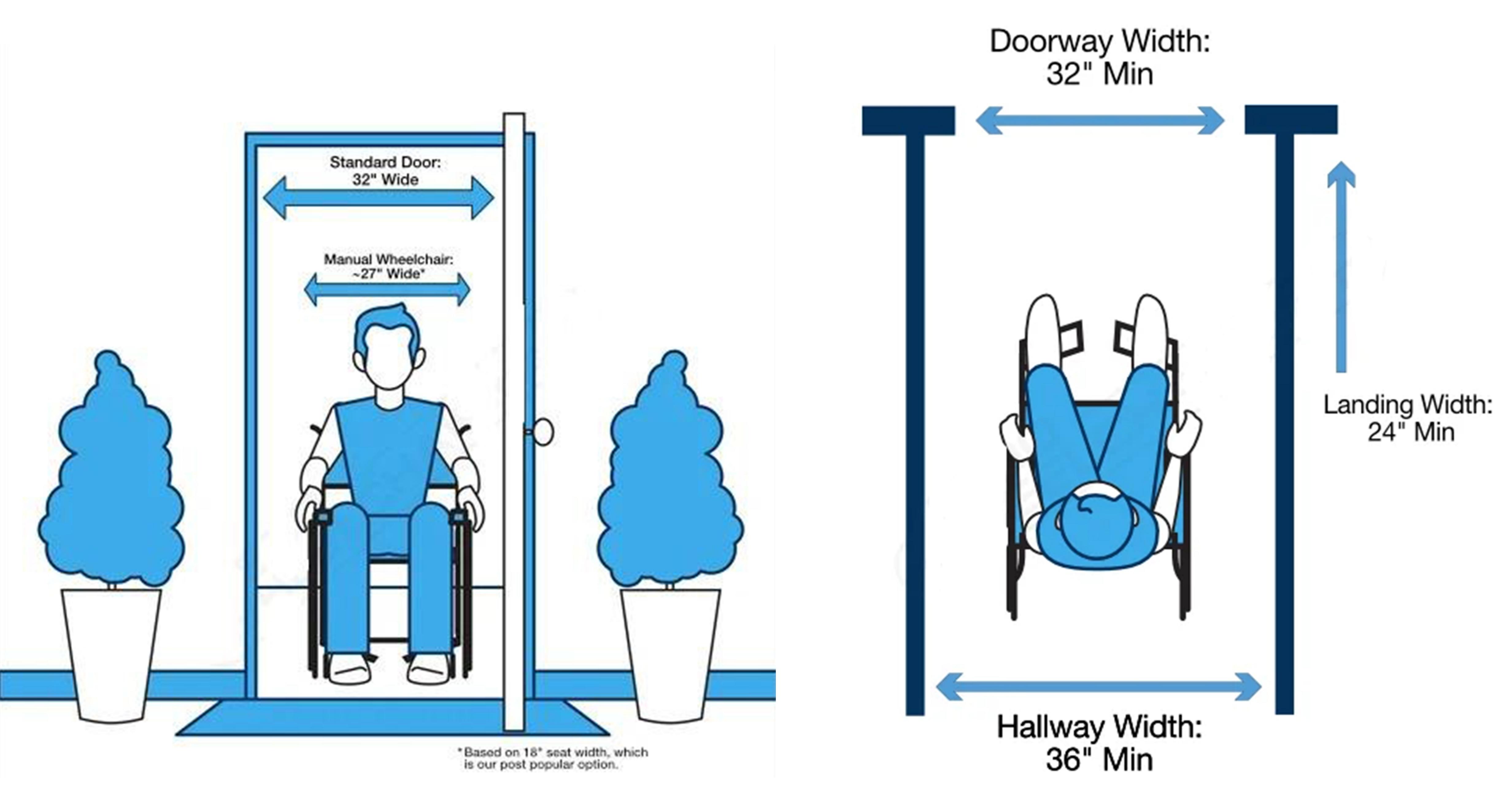
Check Your Doorway Widths First
Doorways are one of the most common accessibility challenges for wheelchair users.
As a general guideline:
|
Door Width |
Accessibility Consideration |
|
24 inches (61 cm) |
Too narrow for most adult wheelchairs |
|
28 inches (71 cm) |
May work for some compact or transport wheelchairs, but clearance is limited |
|
30 inches (76 cm) |
Can accommodate many standard wheelchairs, though maneuvering may be tight |
|
32 inches (81 cm) or wider |
Recommended minimum for comfortable wheelchair access |
It is important to remember that the wheelchair itself is not the only component which will need to pass through the doorway. People who move themselves around will require additional room for their hands and arms.
Think About Hallways and Turning Space
Although you may fit into a door, moving around in the space past the door can be difficult.
For comfortable everyday living:
- Minimum width for hallways: 36 inches (91 cm)
- Suggested width for hallways: 42-48 inches (107-122 cm)
The wider the hallways, the easier it will be to:
- Enter rooms
- Maneuver around furniture pieces
- Avoid bumps into the wall
- Get around easily while the attendant is near you
In case your house has narrow hallways, getting rid of unneeded furniture and other obstacles may help.
Don't Forget the Bathroom
Bathrooms can be one of the most challenging rooms in the home due to small size and numerous transfers.
Space should ideally allow for the following:
- Ability to turn the wheelchair comfortably
- Able to get to the toilet from the side
- Reach the sink without any obstructions
Guidelines for accessibility include the following:
- Turning space: approximately 60 inches (152 cm) diameter circle
- Transfer space to the toilet: at least 48 inches (122 cm) beside the toilet
- Clear floor space in front of the sink: 30 × 48 inches (76 × 122 cm)
If space is an issue, minor adjustments such as removal of storage cabinets, installation of wall-mounted sinks, and replacement of doors from swing to slide may enhance accessibility.
Simple Home Accessibility Checklist
Before choosing a wheelchair, measure:
✓ Narrowest doorway in your home
✓ Hallway width
✓ Bathroom entrance width
✓ Space beside the toilet
✓ Open floor space for turning
Making these measurements before purchasing can help you choose a wheelchair that not only fits your body, but also fits your daily living environment.
Wheelchair Seat Width Based on Comfort
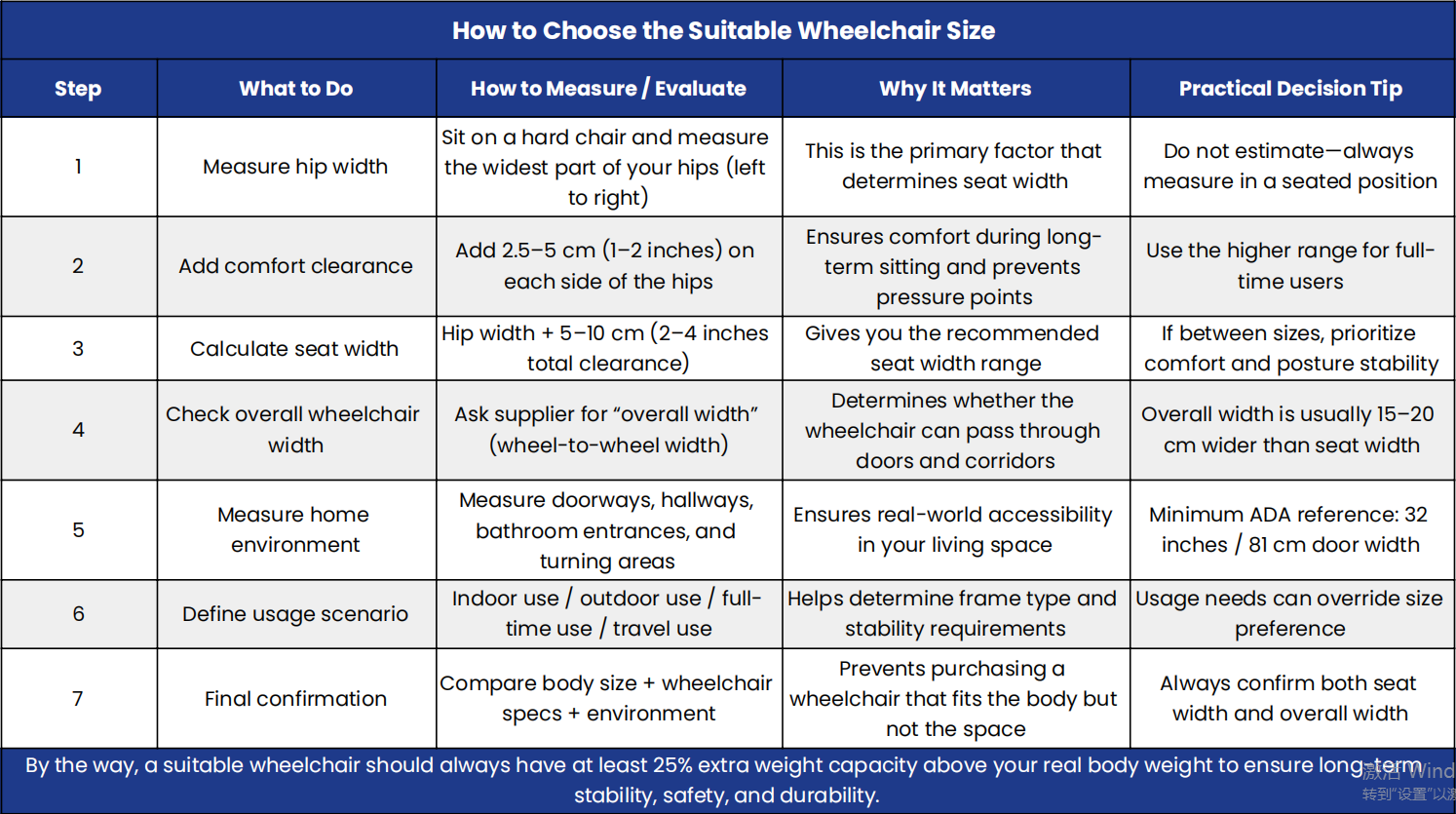
Clinical comfort depends more on the accuracy of fit than on the space available. The seating theory suggests a clearance of 1–2 inches (2.5–5 cm) on either side of the pelvis for the best possible results.
Considerations in the fitting process:
- Underfitting results in pressure on the hips, decreased circulation, skin breakdown, and musculoskeletal pain.
- Overfitting causes postural instability, increased energy expenditure while propelling the wheelchair, increased strain on the shoulders, and lack of control.
Clinical fitting aim:
A correctly fitted wheelchair would create neutral pelvic positioning, balanced pressure, effective upper-limb mechanics of propulsion, and posture stability.
Wheelchair Width Selection Framework
The issue of selecting an appropriate wheelchair width does not lie in the comfort of sitting in it, but rather on its functionality in your day-to-day activities.
There are three parameters that have to be considered here: your body dimensions, space through which you maneuver, and frequency of use of the wheelchair. Where these parameters correspond appropriately, maneuvering becomes significantly easier.
The following are factors to consider when purchasing one.
|
Category |
Key Evaluation Factors |
What to Measure |
Why It Matters |
Practical Insight |
|
Anthropometric Assessment |
Hip width (most important) Shoulder width Thigh positioning & leg angle |
Seated hip width + posture space |
Determines seat width and long-term comfort |
Seat should match body size closely—not too tight, not overly wide |
|
Environmental Assessment |
Doorway width Hallway clearance Turning radius |
Real home and building measurements |
Determines whether the wheelchair can move freely in daily spaces |
Many mobility issues come from narrow doors, not standard wheelchair size |
|
Functional Requirement |
Full-time vs occasional use Self-propulsion vs assisted use Indoor vs outdoor use |
Daily usage pattern |
Affects wheelchair type, frame, and stability needs |
Different usage = different design priorities |
|
Clinical/Practical Selection Logic |
Narrow home environments Long-term independent mobility Outdoor mobility needs Travel/lightweight use |
Overall lifestyle scenario |
Guides final wheelchair category choice |
Compact wheelchair = tight spaces Electric wheelchair = independence Heavy-duty wheelchair = outdoor stability Transport wheelchair = portability |
Common Mistakes When Choosing Wheelchair Width
A frequent error made by wheelchair users (or even their care takers) while selecting wheelchair width is quite similar to each other. Though these errors may not have any significant impact at first place, with passage of time, they can seriously affect your comfort, movement and safety.
- Selection of wheelchair having excessive width, There is a wrong perception regarding wheelchairs which assume that increased width of seat will provide increased comfort. However, increased width not only decreases stability of chair but also makes its movement difficult.
- Getting confused between seat width and whole wheelchair width
- It is important to understand that seat width is not equal to total wheelchair width as total wheelchair width involves wheels, arm rests and structure of frame. Users generally calculate only seat width and regret later on as it does not allow them to move freely inside doors and narrow passages.
- Failure to take into account the restrictions of the actual physical space, A comfortable wheelchair indoors does not necessarily translate to the same level of comfort out in the real world because of restrictions such as doorways, bathroom entry ways, elevators, and tight spaces, among others. Neglecting the above-mentioned restrictions is the cause of the most frequent problems.
- Failure to take into consideration pressure and posture in the long term, It is not uncommon for a wheelchair to be very comfortable when used for a short period of time but unsuitable for long-term use due to improper choice of the width.
- Choosing short-term comfort over practical mobility,Some people base their choice of wheelchair on their immediate comfort, which is much less important than practical mobility.
Key takeaway
The width of the wheelchair must never be selected based on comfort alone. Rather, it is always best to select an optimal width that takes into consideration both your body and environment as well as future mobility requirements.
Conclusion
Among all the considerations, one of the most crucial aspects of selecting the appropriate wheelchair to fit one's personal requirements is wheelchair width. It influences the user's movement in confined spaces and doorways and also plays a role in the ease and comfort with which they sit for an extended period of time.
The optimal choice of wheelchair width is usually not a matter of choosing wider or narrower options but rather a complex combination of parameters depending on the dimensions of the person's body, their activity type, and the environment they operate in. In other words, while selecting the wheelchair, one has to keep in mind the environmental needs of the user along with physiological needs as well.


